Historical Destination
Sevagram — Mahatma Gandhi's
Ashram Village Near Wardha
Where the Father of the Nation lived, worked, and shaped India's freedom movement. Sevagram Ashram near Wardha is a profound spiritual and historical stopover, perfectly located en route to Tadoba National Park.
About Sevagram
Gandhi's Living Legacy in the Heart of Vidarbha
Sevagram, meaning "Village of Service," is a small but profoundly significant village located just 8 kilometres from Wardha in Maharashtra's Vidarbha region. It was here that Mahatma Gandhi, at the invitation of his close friend and philanthropist Seth Jamnalal Bajaj, established his permanent ashram in 1936 — making it his home until India's independence in 1947.
Unlike Sabarmati Ashram in Gujarat, which served as Gandhi's base during the early non-cooperation movement, Sevagram became the nerve centre of India's final push for independence. All major political decisions of the Indian National Congress during this crucial decade were formulated, deliberated, and communicated from this tranquil village in central India.
Gandhi chose Sevagram because of its geographic centrality to the Indian subcontinent and its proximity to the cotton-growing heartland of Vidarbha — a region where farmers and rural communities were deeply exploited. His vision was simple: live among the poorest, serve the most marginalised, and demonstrate that true governance begins with grassroots empowerment.
Today, Sevagram Ashram is meticulously preserved as a national heritage site maintained by the Gandhi Smarak Nidhi trust. Thousands of visitors — students, historians, peace seekers, and curious travellers — come each year to walk the same soil where the Mahatma once spun khadi, meditated at dawn, and received the world's most powerful leaders.
Key Attractions
What to See at Sevagram Ashram
Sevagram is compact yet deeply immersive. Every building, every room, every tool carries the weight of history and the lightness of Gandhi's philosophy.
Bapu Kuti
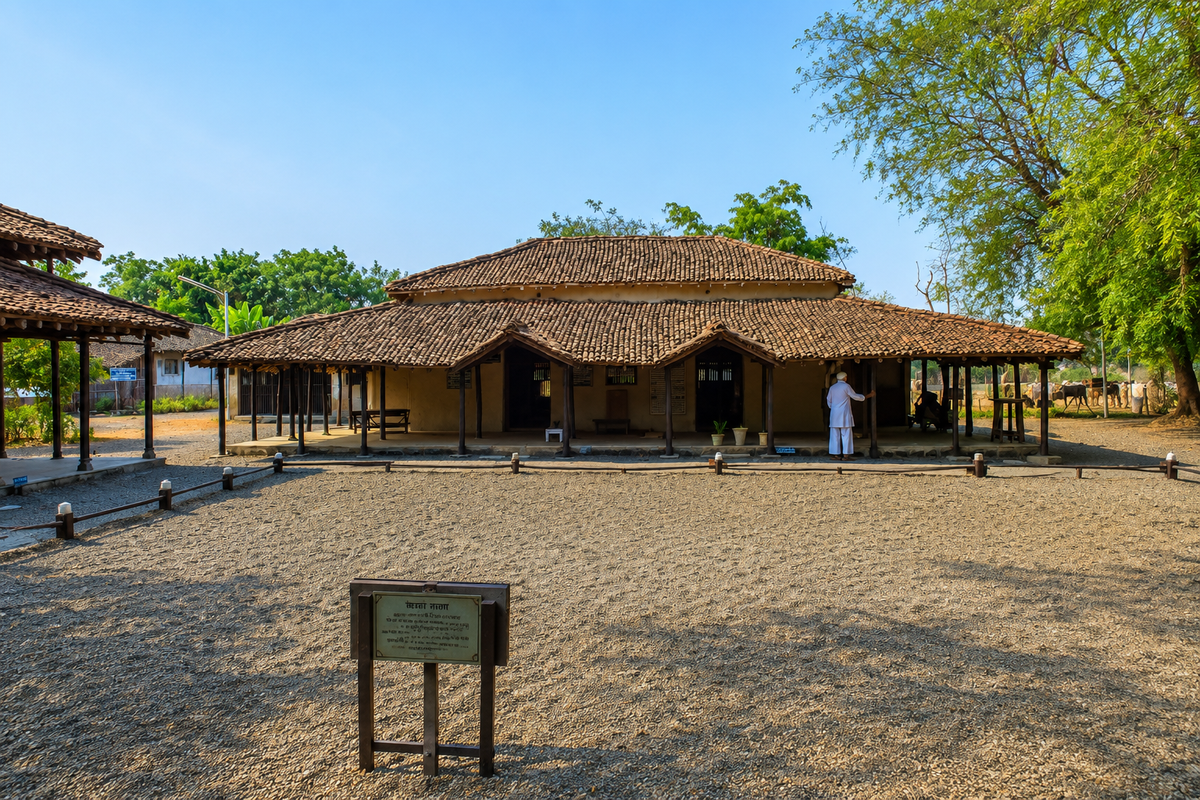
Gandhi's personal living quarters — a modest mud hut that served as his bedroom, prayer room, and workspace for over a decade. The spartan simplicity of the interior speaks volumes about his philosophy of voluntary poverty.
Adi Nivas
The original structure built for Gandhi upon his arrival in 1936, constructed at his specific instructions — no costly materials, no elaborate design, just functional simplicity. Now preserved exactly as it was.
Gandhi Smarak Museum
A comprehensive museum housing rare photographs, personal belongings, correspondence, spinning wheels (charkhas), and manuscripts from Gandhi's most active political years. An essential stop for understanding the freedom movement.
Maganwadi
Gandhi's applied-research village located 2km from Sevagram, established to demonstrate village-level economic self-sufficiency through cottage industries, organic farming, and rural education — the practical manifestation of Gram Swaraj.
🙏 Prayer Ground
The open-air space where Gandhi led daily morning prayers. Bhajans and verses from various religious texts were recited here — a symbol of Gandhi's vision of interfaith harmony and India's composite culture.
📚 Kasturba Nivas
The residential quarters of Kasturba Gandhi, Bapu's wife and an important freedom fighter in her own right. Her life and contributions to the independence movement are documented here with moving detail.
🌳 Nature Trails
The ashram grounds are shaded by ancient trees that Gandhi himself planted. Walking the grounds in silence — as Gandhi once did before dawn prayers — is an experience that stays with every visitor for years.
Historical Context
Why Sevagram Matters to Every Indian
Between 1936 and 1947, Sevagram was arguably the most politically significant village on Earth. From this modest ashram, Gandhi coordinated the Quit India Movement of 1942 — the most decisive mass movement in the history of the Indian independence struggle.
Heads of state, freedom fighters, journalists, and social reformers from around the world journeyed to Sevagram to seek Gandhi's counsel. Leaders like Jawaharlal Nehru, Sardar Vallabhbhai Patel, Maulana Azad, Rajendra Prasad, and international figures including Dr. Martin Luther King's inspirations all engaged with the philosophy that emanated from these humble grounds.
Gandhi's experiments at Sevagram went beyond politics. He ran a Basic Education school (Nai Talim) that became a model for UNESCO-recognised child-centred learning. He developed systems for rural healthcare using natural remedies. He promoted gender equality through active inclusion of women in all ashram activities — radical ideas for 1930s India.
The ashram is also significant for its connection to Vinoba Bhave, Gandhi's closest disciple, who launched the world-famous Bhoodan (Land Gift) movement from Wardha district, redistributing land voluntarily from wealthy landowners to landless farmers across India.
"The true India does not live in its cities, but in its 700,000 villages."
— Mahatma Gandhi, from Sevagram
Directions & Transport
How to Reach Sevagram
Sevagram is exceptionally well-connected and sits on the natural route from Nagpur to Chandrapur and Tadoba, making it an ideal combined trip.
By Air
The nearest airport is Dr. Babasaheb Ambedkar International Airport, Nagpur — approximately 75 km from Sevagram. Nagpur has excellent flight connectivity with Mumbai, Delhi, Hyderabad, Pune, Bengaluru, and all major Indian cities. From Nagpur airport, hire a cab directly to Sevagram (1.5–2 hours).
By Train
Sevagram Railway Station is on the Nagpur–Wardha–Ballarshah main line. Direct trains connect Sevagram to Nagpur (75 km, ~1.5 hrs), Wardha (8 km, 15 min), Mumbai, Hyderabad, and Chandrapur. The station is just 2 km from the ashram, making it the most convenient mode of travel.
By Road
Sevagram is on National Highway 44 (Nagpur–Hyderabad). From Nagpur: 75 km via NH-44 (1.5 hrs). From Wardha city: 8 km. From Chandrapur: 155 km via Warora. The road is excellent quality throughout. MSRTC buses also run frequently from Wardha and Nagpur to Sevagram.
Strategic Location
Sevagram to Tadoba: ~100 km
Sevagram sits almost perfectly between Nagpur and Tadoba National Park, making it an ideal stopover destination. Most Tadoba-bound travellers from Nagpur naturally pass close to Wardha, allowing a seamless half-day visit to Sevagram before continuing to the tiger reserve.
The recommended route is: Nagpur → Sevagram (75 km) → Wardha → Chandrapur → Tadoba (100 km from Sevagram). The total journey from Nagpur to Tadoba via Sevagram adds only 30–45 minutes to your travel time, making it an extremely rewarding detour.
Seasonal Guide
Best Time to Visit Sevagram
The cool and dry winter months are perfect for visiting Sevagram. Temperatures range between 10°C–28°C, making outdoor exploration of the ashram grounds, nature walks, and open-air prayer ground visits extremely comfortable. Visibility is excellent and skies are clear.
Temperatures soar to 40–45°C in Vidarbha during summer. While the ashram is open, outdoor walks are exhausting. If you must visit, go early morning (before 9 AM) and carry ample water. Note that Tadoba National Park remains open in summer and offers excellent tiger sightings.
The ashram grounds are beautifully green and lush in monsoon, but heavy rainfall can make outdoor exploration difficult. Indoor museum and hut visits remain accessible. Note that Tadoba National Park is typically closed during monsoon (July–October), so plan your combined trip accordingly.
Trip Planning
Sevagram + Tadoba Safari — Perfect 3-Day Itinerary
Combine historical enlightenment at Sevagram with wildlife thrills at Tadoba for the ultimate Maharashtra experience.
Nagpur → Sevagram → Chandrapur
- 🌅 Early morning flight or train to Nagpur
- 🚗 Drive to Sevagram Ashram (75 km, ~1.5 hrs)
- 🏛 Morning visit: Bapu Kuti, Adi Nivas, Museum
- 🌾 Afternoon: Maganwadi exploration
- 🚗 Drive to Chandrapur/Tadoba (100 km, ~2.5 hrs)
- 🌙 Check in to your Tadoba jungle resort
Full Day Tadoba Safari
- 🌅 Early morning jeep safari (6:00 AM)
- 🐯 Tiger sighting at core zones
- ☕ Breakfast & resort relaxation
- 🦚 Evening safari (3:00 PM)
- 🐘 Gaur, sambhar, wild dogs at waterholes
- 🌙 Bonfire dinner at resort
Morning Safari → Nagpur
- 🌅 Final morning safari (6:00 AM)
- 🐊 Crocodile & bird spotting at Tadoba Lake
- 📸 Photography at scenic viewpoints
- 🚗 Drive back to Nagpur (145 km)
- 🛍 Visit Wardha or Nagpur market
- ✈ Evening flight home
Explore More
Nearby Attractions to Sevagram
Wardha City
Wardha is a historically important city with connections to the freedom movement. Visit the Datta Mandir, explore the markets, and see the Paunar Ashram of Vinoba Bhave.
Paunar Ashram
Vinoba Bhave's ashram on the banks of the Dham river. The Brahma Vidya Mandir here continues Gandhi's values — managed entirely by women, self-sufficient, and deeply spiritual.
Nagpur City
Orange capital of India. Explore the famous Deekshabhoomi, Ambazari Garden, Sitabuldi Fort, and enjoy the city's renowned orange barfi and saoji cuisine before your Tadoba safari.
Tadoba National Park
Maharashtra's premier tiger reserve with one of India's highest tiger densities. Perfect complement to Sevagram — from Gandhi's peace legacy to the roar of the wild.
Chandrapur City
The ancient city near Tadoba with the famous Mahakali Temple and historical Chandrapur Fort. A rich cultural stop on your wildlife travel route through Vidarbha.
Ramtek
An ancient hilltop temple town near Nagpur, associated with Lord Rama and the poet Kalidasa. The Ramtek Fort and temple complex offer stunning views over the Vidarbha landscape.
Frequently Asked Questions
Sevagram Ashram — Visitor FAQs
Sevagram Ashram is open daily from 8:00 AM to 6:00 PM. Entry to the main ashram premises is free of charge. However, entry to Bapu Kuti (Gandhi's personal hut) requires a nominal fee. Photography is permitted in most areas. The museum has a small separate entry charge. The ashram is closed on national holidays when special programmes are often held.
A thorough, meaningful visit to Sevagram Ashram typically takes 2 to 3 hours. This includes all the major attractions: Bapu Kuti, Adi Nivas, Kasturba Nivas, the prayer ground, and the Gandhi Smarak Museum. If you also visit Maganwadi (2 km away), add another 45–60 minutes. For travellers on a tight Tadoba itinerary, a focused 2-hour visit is sufficient to experience the essence of the ashram.
Absolutely, yes. Sevagram adds a profound historical and cultural dimension to what might otherwise be a purely wildlife-focused trip. Since it lies almost perfectly on the Nagpur–Tadoba highway route, visiting Sevagram adds only 30–45 minutes to your total travel time. The contrast of Gandhi's peaceful ashram with the wildness of Tadoba's forests makes for an incredibly memorable and complete Maharashtra experience.
Yes. The Sevagram Ashram itself operates a visitor's hostel with very basic accommodation for those wishing to experience ashram life — early morning prayers, vegetarian meals, and community service. Wardha city (8 km) has several comfortable hotels. However, most Tadoba-bound travellers prefer to drive directly to their Tadoba resort after a morning/afternoon visit to Sevagram. We recommend premium Tadoba resorts for your overnight stay.
Explore Tadoba